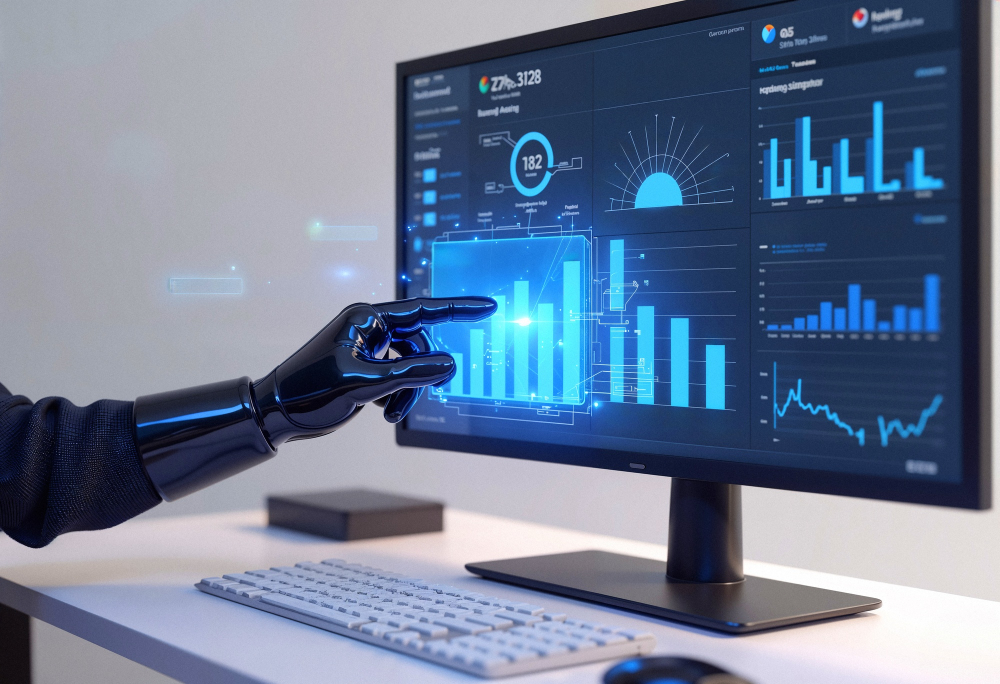
In today’s manufacturing environment, companies face rising costs, global competition, and fast-moving customer demands. Therefore, combining ERP software with intelligent tools has become essential. When smart factories merge data systems, production lines, and analytics through AI enabled ERP, they unlock new levels of performance. Moreover, the convergence of digital and physical operations is redefining how manufacturing works. Factories are evolving into agile, data-driven ecosystems rather than traditional assembly lines. Industry data show that over 77% of manufacturers have already implemented AI in some form. Source: erptoday Additionally, AI-ready platforms are projected to accelerate value exponentially within the next years.
As a thought-leader in digital transformation, I believe that only manufacturers who integrate AI into their manufacturing backbone will remain competitive. This is not simply about technology—it’s about rethinking core workflows, empowering people, and creating resilient operations.
AI in ERP: How Smart Factories Gain a Competitive Edge
Smart factories demand high levels of visibility, agility, and efficiency. That is why AI in ERP plays a key role. For example, predictive maintenance powered by data from machines can prevent unplanned downtime. Real-time analytics enable quicker decisions across production, quality, and supply chain functions. Consequently, factories that adopt AI-enabled platforms see measurable gains. According to one market source, AI adoption in ERP helped reduce operational costs by up to 30%. ZipDo Additionally, a survey revealed that 82% of manufacturers plan to increase AI budgets in 2025 to build “AI-ready ERP” systems.
By embedding intelligence into existing systems, manufacturers can leap from reactive mode into proactive operations. They can forecast demand, optimize schedules, manage inventory, and minimize waste—all within one unified architecture.
Why ERP for Smart Factories Matters More Than Ever
Legacy systems no longer suffice in a world where speed and complexity define manufacturing success. That is why ERP for smart factories is becoming the backbone of next-gen operations. Disparate systems create silos, delay decisions, and inflate costs. In contrast, integrated platforms unify workflows and data streams. They allow factories to track goods, machines, and people in real time.
Furthermore, as Industry 4.0 technologies—IoT, robotics, AI—become mainstream, manufacturers need systems ready for integration and scale. That’s where the right ERP architecture shines: modular, flexible, and future-proof.
Key Benefits of AI + ERP in Manufacturing
1. Enhanced Operational Visibility
With AI integrated into production workflows, smart factories gain end-to-end visibility. Data flows from sensors to dashboards, enabling informed decisions. Managers view performance, logistics, and quality in real time—thus reducing delays and bottlenecks.
2. Predictive Maintenance & Reduced Downtime
AI-enabled ERP uses analytics to predict when machines will fail or need service. This prevents unplanned downtime, extends asset life, and reduces maintenance cost. Smart factories can shift from reactive repair to planned upkeep.
3. Optimized Supply Chain & Inventory Management
When intelligence meets ERP architecture, inventory gets smarter. AI forecasts demand, tracks parts, and recommends actions. Therefore, smart factories avoid over-stocking, reduce waste, and improve cash flow.
4. Quality Control and Compliance
Quality is non-negotiable in modern manufacturing. AI-enabled ERP monitors production and flags defects before they escalate. Additionally, compliance with regulations and standards becomes automated. As a result, factories operate with fewer errors and higher customer satisfaction.
5. Scalability and Future-Readiness
Smart manufacturing is about growth, innovation, and agility. With the right ERP foundation, factories can scale operations, add new lines, and integrate emerging tech. That means when AI, robotics or new workflows arrive, the system supports evolution rather than hinders it.
Overcoming Barriers to Adoption
Despite the promise, many manufacturers hesitate. Data quality, integration issues, and skills gaps often block progress. For instance, one survey found nearly half of factories felt their systems were not ready for AI. Moreover, change management and culture shift present real challenges. My experience shows that success comes when leadership champions the initiative, teams receive training, and incremental wins build momentum.
Transforming to a smart factory with AI + ERP must focus on people, processes, and technology—not just tools. When these elements align, manufacturers unlock true operational excellence.
Real-World Example and Outcomes
Consider a mid-sized manufacturer that implemented AI‐powered analytics within their manufacturing ERP platform. Within 12 months they achieved:
- 25% reduction in unplanned downtime
- 20% improvement in production throughput
- 18% reduction in resource waste
With data flowing seamlessly from machines to dashboards, teams shifted from firefighting to proactive optimisation. Smart manufacturing met operational efficiency in real time.
ERP for Smart Factories: The Strategic Path Forward
Adopting ERP for smart factories is not simply a technology decision—it is a strategic business choice. As a thought-leader, I argue that any manufacturing firm ignoring this convergence risks falling behind. The competitive set is moving fast; new entrants, digital natives, and agile players are raising the bar.
By investing in an ERP backbone that supports AI, manufacturers gain:
- Agility to respond to market swings
- Efficiency through unified operations
- Innovation potential through data-driven insights
- Resilience amid supply chain disruptions
Manufacturers must start with clear vision, measurable objectives, and structured roadmap. Focus on quick wins—like predictive maintenance or demand forecasting—and then scale. Partnering with vendors who understand both AI and industrial processes is key.
Conclusion: Embrace AI + ERP Now
In conclusion, the future of manufacturing lies at the intersection of intelligence and integration. AI enabled ERP isn’t a luxury—it’s a business imperative for smart factories. When you combine a robust ERP backbone with AI capabilities, the result is operational excellence that rivals the world’s best.
If your factory remains stuck in outdated workflows, disconnected systems, and manual processes, now is the moment to act. Embrace the transformation, invest in your system, empower your teams—and lead the next wave of smart manufacturing.